
New methodologies

New method of separating merged motor unit discharge trains
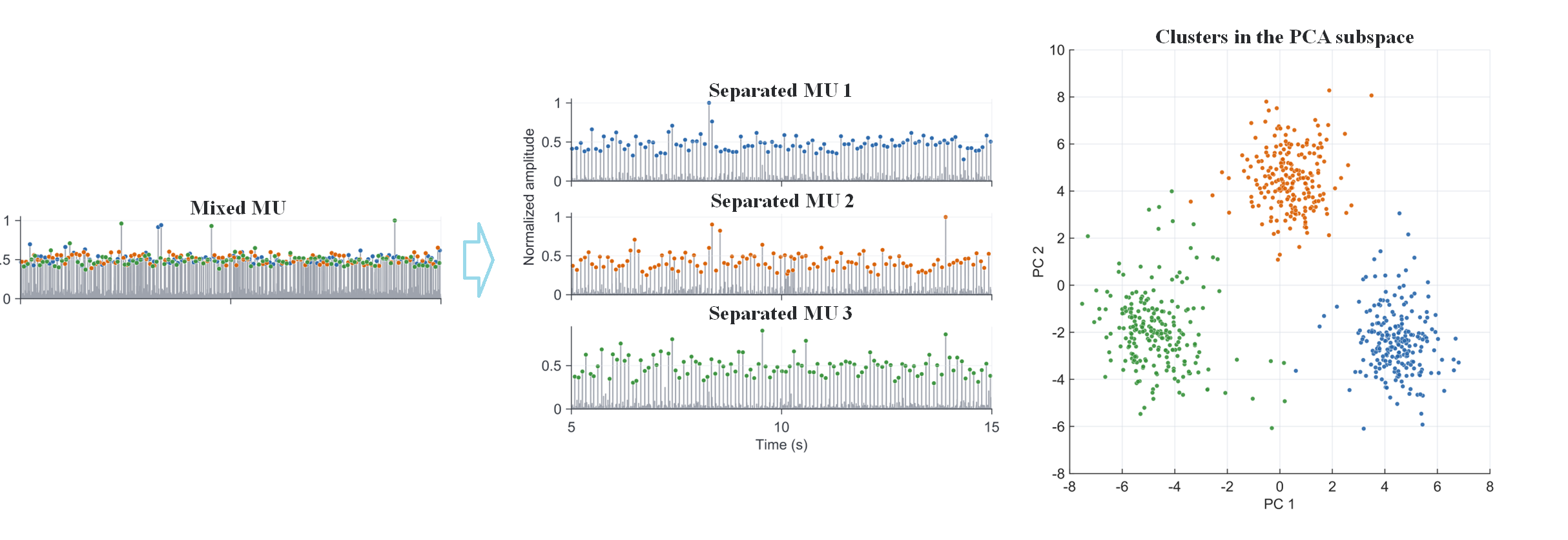
A mixed motor unit signal, three separated discharge trains, and a principal component plot with the corresponding blue, orange and green clusters.
View the separation figure at full size

Decomposing high-density electromyographic signals allows us to non-invasively assess the activity of individual motor units. However, reliable interpretation of physiological changes in health and disease depends on the accurate detection of motor unit discharges.

When high-density surface EMG recordings are decomposed, discharges from more than one motor unit can sometimes be merged within a single estimated discharge train. Our method uses principal component analysis (PCA) to identify subtle differences in motor unit action potential profiles and uses these differences to group the discharges and recover separate trains for each motor unit.

In simulated recordings, it is estimated that the method increased the accuracy of discharge identification by approximately 40% for these mixed motor unit sources. In experimental recordings, it increased motor unit yield and reduced the variability of motor unit firing.

New method to track motor units across recordings using their multi-dimensional action potential trajectory

Following the same motor unit longitudinally over consecutive trials or under different experimental conditions, referred to as motor unit tracking, is a current challenge in the field. The ability to reliably track the same motor unit across multiple recordings provides insight into the changes in motoneuron discharge patterns that occur over time, under different conditions, or in response to specific interventions.

The standard approach for tracking motor units across trials uses two-dimensional cross-correlation to match motor unit action potential waveforms based on their similarity. A change in waveform shape can cause a true match to be missed, while similar waveforms from different units can be mistaken for a match. Our method represents each action potential as a trajectory, with one dimension per high-density surface EMG channel. Features of the trajectory capture how signals across electrodes change together as the action potential unfolds.

Across simulated and experimental datasets, our method correctly identified 89.8% of matching pairs, compared with 73.3% at the best-performing cross-correlation threshold. It also reduced the false positive rate by 49.6%.

The code for multi-dimensional motor unit tracking is available in the MD-Tracking repository on GitHub.